Carbon Dioxide (CO2) emissions are a major contributor to global warming and their impact is growing.[1] The 10 warmest years in the historical record have all occurred since 2010. [2] The built environment generates 40% of annual global CO2 emissions. Of this, ‘building operations’ contribute 27% annually. In 2040, 2/3 of the global building stock will include those of today. [3] So, without any upgrades, they will still be contributing to annual CO2 emissions. With businesses returning to the offices, the growth of urbanization and people seeking better shopping or dining experiences, it is imperative to make building operations sustainable. [4] [5] [6] [7]
Chief Information Officers (CIOs) of organizations with multiple buildings in a portfolio, already play a critical role in helping their organizations achieve the stated sustainability goals. Making building operations more efficient can also contribute to reaching these goals. In this article, we'll explore how Managed Services, specifically leveraging AIoT (Artificial Intelligence of Things), can help organizations achieve sustainable building operations seamlessly and efficiently and how CIOs have a pivotal role to play here as well.
The Evolution of Managed Services
Managed Services have their roots in Information Technology (IT) outsourcing but have evolved to encompass a range of services, including building operations. The growth of Managed Services has been significant, with the global Managed Services market expected to reach $350 billion by 2025. [8] This model is successful, and its use is only growing.
The benefits of Managed Services include:
- Increased efficiency
- Agility in innovation
- Best practices across customer groups
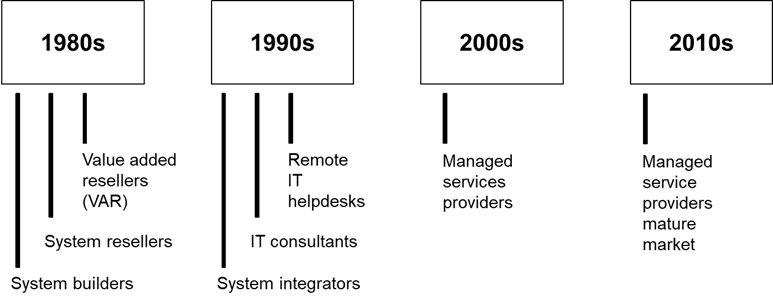
Evolution of Managed Services Providers in IT.[9] In 2023, established service providers bring all the learnings from this evolution to the table on day 1, applying the best practices of Managed Services – for deploying AIoT solutions for building operations.
While various business functions beyond IT, have already embraced Managed Services, the adoption has primarily been to the ‘people function’ of the business - such as accounting, customer service, etc. There have been limited areas where the direct involvement of the CIOs was required, as there was no technology dependency.
However, with the advent of AIoT-driven building operations, CIOs will need to play a much bigger role. As experienced CIOs, you are well aware of the benefits and value that managed services bring to the table. With the growing IT and OT convergence – the integration of information technology (IT) systems with operational technology (OT) systems – a CIO’s role is more crucial to the successful adoption of AIoT in building operations.
Leveraging Managed Services for Building Operations
As a CIO, your familiarity with Managed Services in the IT realm will be crucial in guiding facility teams to adopt this approach for building operations. You have witnessed the evolution of Managed Services in IT, experienced the pain points, and discovered better ways to optimize outputs. By leveraging your expertise, you can lead your facility teams toward embracing Managed Services to streamline building operations and achieve sustainability goals.
The Power of Managed Services
Historically, IoT and analytics projects have faced challenges and high failure rates. However, in 2023, the landscape will have evolved. With the expertise gained from Managed Services in the IT realm, you can help your facility teams navigate the complexities of IoT implementation and avoid common pitfalls.
Managed Services offer a way to avoid these pitfalls and achieve numerous benefits for building operations. Firstly, they enhance efficiency by leveraging AIoT, automation, and analytics to optimize energy usage, streamline maintenance processes, and identify areas for improvement. Real-time data and insights enable proactive decision-making, leading to more sustainable operations.
By collaborating with Managed Services providers, you can digitally transform building operations. You gain access to their deep knowledge and experience in building systems, data analytics, and automation technologies. They can guide you through the landscape, helping you select the right AIoT devices and sensors, design scalable architectures, and implement robust data management strategies. With their expertise, you can avoid common pitfalls and ensure a smooth and successful implementation of AIoT technologies.
For example, a leading retailer with over 2,000 stores in North America, partnered with a Managed Services provider to digitally transform their building operations in 2013, integrating AIoT technology to monitor energy usage, HVAC systems, and lighting. Over the course of the last 10 years, they have digitally transformed their building operations – to be more proactive, leveraging predictive insights from AI and automation enabled by IoT. In the same period, they have been able to increase savings per year, from less than 5% in the first year of the engagement to over 24% in the 10th year. This illustrates how the value delivered by the services also increased year on year. The service provider also delivered additional services in maintenance cost optimization and temperature compliance monitoring, allowing the retailer to achieve its business goals while making building operations more sustainable.
Meeting Building Operations Teams’ Concerns
Operations teams and in particular facility managers, may have concerns when it comes to adopting Managed Services. Common questions include whether the transition will disrupt current operations, if they will maintain control over their building operations, and if Managed Services are suitable for their specific industry or building type. It's essential to address these concerns and provide reassurance. Managed Services are designed to seamlessly integrate with existing infrastructure, ensuring minimal disruption and a smooth transition. Facility managers retain control while gaining real-time insights and the ability to make informed decisions to enhance building operations. Capable Managed Services providers offer customizable solutions tailored to the unique requirements of various industries and building types.
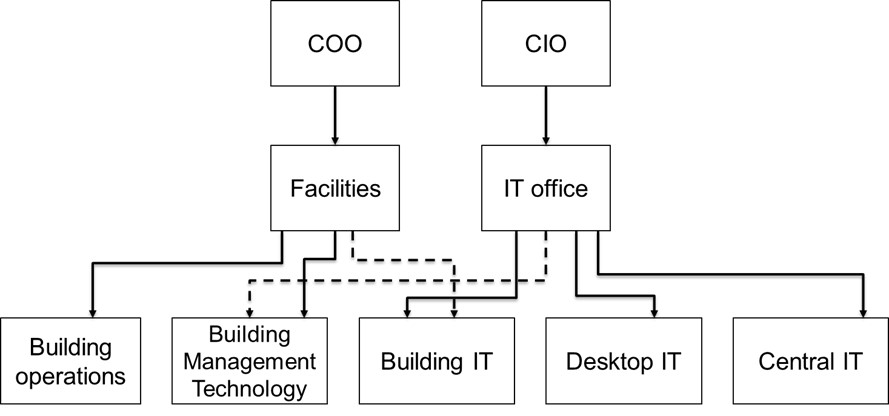
Example of a governance model.[10] CIOs are deeply involved in the IT/OT convergence and are best positioned to guide the adoption of Managed Services to deploy AIoT to make building operations more sustainable.
Conclusion
For CIOs overseeing companies with multiple building operations, where the digital transformation of building operations is afoot, embracing the Managed Services model can be crucial to success. Instead of leveraging point solutions in the market and then trying to integrate them in-house, CIOs can leverage the expertise of Managed Services providers to realize the true potential of the selected technologies. The providers will deploy, manage and optimize the solution to meet the organizations’ goals.
By leveraging your expertise, you can guide the way for your organization to optimize energy usage, streamline maintenance processes, and thereby reduce emissions. Help your organization embrace the power of Managed Services for building operations and pave the way for a more sustainable future.
Author: Vikesh Mehta
Vikesh Mehta is the Global Delivery Head for EcoEnergy Insights. He manages the solution delivery for EcoEnergy Insights diverse customer accounts worldwide in a global delivery model. Vikesh brings over 25 years of experience spread across IT, Telecom and Building domain with diverse roles & responsibilities in Customer Service, Technical Support, Systems Integration, Service Engineering, Innovation & Patent Management. He has been part of variety of Outsourcing & Managed Service customer delivery programs across US, Europe and India. His motto in life is – “In a Fast World, Think Slowly”.
References:
- Overview of Greenhouse Gases – United States Environment Protection Agency
- Climate Change: Global Temperature – National Oceanic and Atmospheric Administration Climate.gov
- Why the Built Environment? – Architecture 2030
- Here's a list of major companies requiring employees to return to the office – Business Insider, May 30, 2023
- Urban Development – The World Bank
- Shoppers Still Value In-Store Retail Experiences – Forbes
- Customers will want to choose their own experience in a post-pandemic world – Nation’s Restaurant News
- Managed Services Market – Markets and Markets
- What Is an MSP: History of the Managed Service Provider – Endsight
- Converge IT and OT to turbocharge business operations’ scaling power – McKinsey & Company