
Beyond Traditional Operations: Managing the Connected Restaurant
India’s restaurant industry in growing rapidly. From large Full-Service Restaurants (FSRs), Quick Service Restaurants (QSRs) to cloud kitchens, businesses are expanding. The industry is valued at $85.19 billion in 2025 and projected to reach $139.8 billion by 20301.
Despite the growth opportunity, restaurant operators continue to navigate a range of operational and business challenges such as customer loyalty, overall restaurant management, maintenance requirements, policy constraints and rising cost pressures2. According to National Restaurant Association, 42% restaurants were not profitable in 20253. It has therefore become important for restaurant operators to manage operating costs.
The growing pressure on cost is reshaping restaurant operations. What was once driven primarily by location, menu innovation, and service consistency is now also being reshaped by other complex operating realities that are driving up operating costs. These include rising energy costs, critical equipment breakdowns, stricter food safety compliance, and sustainability commitments. In this environment, Artificial Intelligence (AI) and Internet of Things (IoT) are gradually moving beyond back-of-house efficiency to support more intelligent, resilient, and profitable restaurant operating model4.
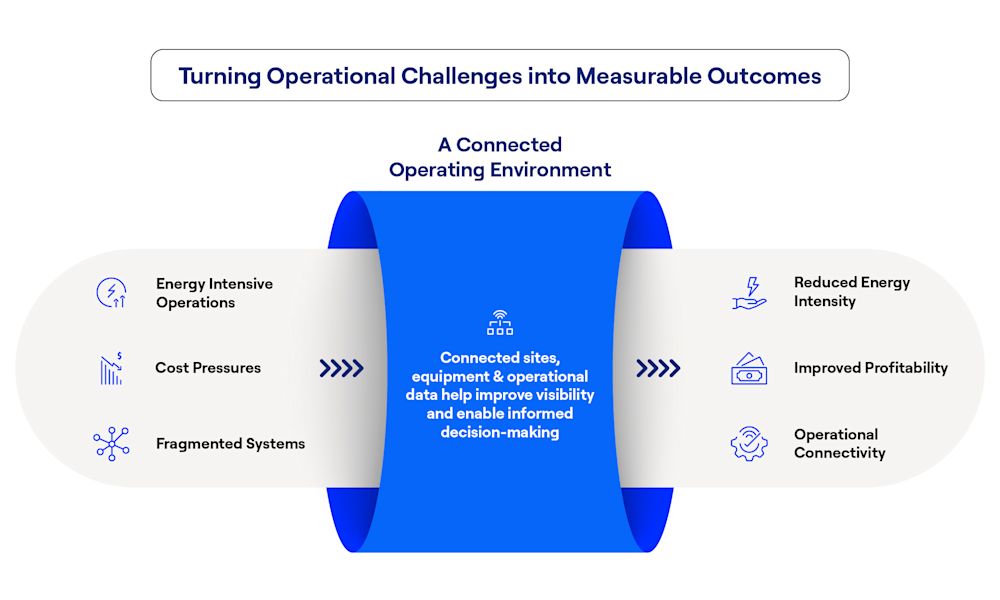
The real opportunity lies in going beyond isolated restaurant-level automation to connected operations – where Heating, Ventilation, and Air-Conditioning (HVAC), refrigeration, kitchen equipment, and lighting systems are integrated to provide a unified, data-driven view of performance. This enables operators to optimize energy consumption, improve equipment reliability, and manage restaurant operations more proactively in real time.
Connected operations help create a direct link between data, decision-making, and business outcomes. By bringing together information from critical systems, operators can identify opportunities, act on them more quickly, and measure their impact on cost, performance, compliance, and sustainability.
This can be seen across a few critical operational areas within the restaurant.
1) Energy Management as a Driver of Cost and Performance
Restaurants are among the most energy intensive commercial environments5, with cooking, refrigeration, HVAC, lighting, and dishwashing systems operating simultaneously for extended hours. This not only drives up operating costs but can also increase energy consumption, which now needs to be tracked as part of many companies’ Environment, Social, and Governance (ESG) commitments. As a result, energy efficiency is not only a sustainability discussion; it is becoming a direct lever for margin improvement, as even small reductions in energy use can translate into immediate, measurable savings.
A smart restaurant manages energy with the same discipline as managing inventory — through visibility, tracking and measurement & verification. AI and IoT can enable this by connecting critical systems and allowing them to respond dynamically to occupancy levels, operating hours, and variable weather conditions, rather than running on static schedules.
In practical terms, this can translate into reducing avoidable energy consumption across empty dining areas, closed zones, storage spaces, and non peak periods. Additionally, it allows operators to move from reactive energy management to a more consistent and controllable operating discipline where costs, performance, and sustainability outcomes are managed together, rather than in isolation.
A large food service company in India deployed an AI-enabled platform across 1,900 restaurants for real-time monitoring and automated setpoint control. Between Aug’14 and Feb’26, this resulted in reported savings of over 58 million kWh of energy, translating to more than Rs. 735 million in energy cost savings**.
2) Strengthening Food Safety Through Continuous Refrigeration Monitoring
Refrigeration is one of the most critical areas for restaurants because it sits at the intersection of food safety, spoilage prevention, regulatory compliance, and electricity consumption. Connected refrigeration systems can monitor temperature, defrost cycles, long door openings, compressor health, and abnormal consumption patterns in real time to help identify performance deviations early — before they contribute to food spoilage, service disruption, or higher maintenance costs.
For restaurant operators, the value is not just visibility. It is also the ability to help reduce the risk of food safety violations by maintaining cold room performance more proactively across their restaurant network using prescriptive recommendations generated by an AI-enabled platform.
In one deployment at a leading fried chicken restaurant operator in India, continuous monitoring helped maintain cold-room chiller temperature internal compliance at an average of 89% between Nov’16 to Mar’26. This level of consistency, over nearly a decade, helped support product shelf life, reduce premature spoilage risk, and adherence to food safety temperature standards**.
3) Integrated Air-Conditioning and Demand-Controlled Ventilation
Air conditioning should no longer be treated as an independent utility by restaurant operators. In practice, this requires a more integrated approach — what can be termed as soft integration. Soft integration refers to embedding HVAC into a connected operating environment, where cooling is aligned in real time operational requirements. Some of the smart HVAC assets enable seamless integration with AI- and IoT-enabled systems through built-in communication interfaces. Restaurant operators can realize savings in two phases: the first through intelligent controls, followed by additional savings from the early detection of performance degradation and component failures.
The restaurant environment is influenced not only by cooling systems but also by how heat, smoke, grease, and odors are managed within the kitchen. This makes ventilation a critical component of both customer comfort and energy efficiency. Demand Controlled Kitchen Ventilation (DCKV) is an automated system designed to optimize exhaust, chimney, and makeup air fans based on real-time cooking activity. Instead of operating exhaust hoods at full capacity throughout the operating hours, DCKV automatically adjusts airflow in response to heat, smoke, and steam levels, which can help improve energy efficiency while supporting a clean and comfortable dining environment.
4) Managing Sustainability Through Measurable Outcomes
For many Indian restaurants, sustainability is increasingly moving from a branding narrative to an operating discipline. What was once driven by intent and perception is now shaped by measurable outcomes and accountability.
Achieving these outcomes often involves integrating sustainability initiatives into day-to-day operations rather than managing them as standalone efforts. Energy-efficient equipment, optimized HVAC, waste reduction, digital processes, EV-led delivery, and data-driven procurement all can contribute to how energy, resources, and costs are managed across the business.
AI and IoT supports this transition by helping operators move from periodic reviews to continuous action. Instead of relying on retrospective reporting, operators can use operational data to identify inefficiencies, prioritize interventions, and track the impact of sustainability initiatives over time. This creates a more structured approach to managing energy consumption, resource utilization, and operational performance.
Across the same 1,900 restaurants referenced earlier, the AI-enabled platform delivered average energy savings of 7.9% between Aug’14 and Feb’26. These savings translated into the avoidance of over 39,000 metric tons of carbon emissions6 from restaurant operations**.
This demonstrates how sustainability initiatives, when integrated into operations, can translate into measurable performance outcomes.

Leading the Shift to Connected Restaurant Operations
For many restaurant leaders, the question is no longer whether to adopt AI and IoT. The more relevant questions are where these technologies can drive measurable business value, how can data be integrated across critical systems, and how can this intelligence be embedded into daily operations.
Many of the operators that will lead this shift are those that treat AI and IoT not as discrete technology deployments, but as the foundation of a connected operating model. For them, there is an opportunity to move beyond isolated technology deployments and focus on how systems, data, and operational decisions can work together. The objective goes beyond digitizing individual functions and onto creating a connected operating environment where insights can be translated into measurable business outcomes. In certain implementations, restaurant operators who have adopted AI and IoT have realized up to 9% energy savings**.
Many of the organizations making the most progress are not approaching AI and IoT as just technology projects. They are also treating them as operational tools that help create visibility, guide better decisions, and ultimately translate those decisions into measurable business outcomes. This positions them to scale connected operations more effectively and unlock value across a larger restaurant network.
Restaurants that succeed in this transition can be better positioned to manage costs, improve equipment performance, support food safety objectives, and advance sustainability goals while delivering a consistent guest experience.
Author Bio
Joydeep Banerjee leads Customer Success for India, helping multi-site customers maximize value from AI- and IoT-enabled energy management programs. He helps customers advance digital transformation across their operations, enabling them to improve performance and accelerate their Environmental, Social, and Governance (ESG) goals.
References
1https://www.mordorintelligence.com/industry-reports/india-foodservice-market
2https://www.restaurantindia.in/article/key-operational-challenges-to-address-if-you-own-a-restaurant.13204
3https://hospitalitytech.com/2026-restaurant-technology-study
4https://www.scirp.org/journal/paperinformation?paperid=148794
5https://www.eia.gov/consumption/commercial/pba/food-service.php
6https://www.epa.gov/energy/greenhouse-gas-equivalencies-calculator
Disclaimers
*AI-generated output may include inaccuracies. Users should verify important information independently
**This deployment is based on a specific implementation and reflects the experience of a particular customer under its unique circumstances. Results may vary.