
The Evolving World of Facility Management: Challenges, Smarter Solutions & the Path Forward
by Steve Hamby, Business & Technology Leader and Shawn Menezes, Brand & Product Marketing, Carrier Abound
JUNE 2026
Facility managers operate at the frontlines of complexity. Most mornings begin with e-mails and messages from multiple locations, each one demanding immediate attention. Behind every building is a complex web of processes that must run seamlessly supporting occupant well-being, regulatory compliance readiness, energy efficiency, and uninterrupted operations. Building operations are critical because when they are disrupted, it affects business operations and profitability.
Yet the demands on facility teams continue to grow. Many leaders expect stronger outcomes across energy performance, compliance, and occupant experience, all at once. While teams can rise to the challenge, working with disconnected data and complex decisions creates constant strain and limited visibility.
To respond to growing demands, facility managers need a more strategic partnership with technology. A new model is emerging; one that blends human judgment with analytics and connected insights. This model is further strengthened by managed services that extend operational capabilities. Together, these capabilities bring greater clarity, enable more coordinated action, and support confident decision-making.
How AI & Human Intelligence Work Together
At the core of this shift is a new operating model that brings AI-driven technology and human expertise together. As facility operations become more complex, the role of the facility manager is evolving alongside them.
AI supports scale, speed, and the ability to frequently analyze patterns across vast portfolios of data. Command Centers, staffed with experts, add context, operational experience, and strategic judgment enabling translation of insights into meaningful action. Together, when deployed as a managed service, they create greater operational clarity and more informed decision-making.
This partnership transforms how teams operate day to day. Time spent on collecting and analyzing data is reduced, freeing capacity for prioritization and strategic decisions. Predictive intelligence helps anticipate issues, while expert oversight validates actions and guides execution. Technicians receive more targeted direction, and leadership gains clearer visibility into performance.
The result is Facility managers that are better supported, more proactive, and informed.
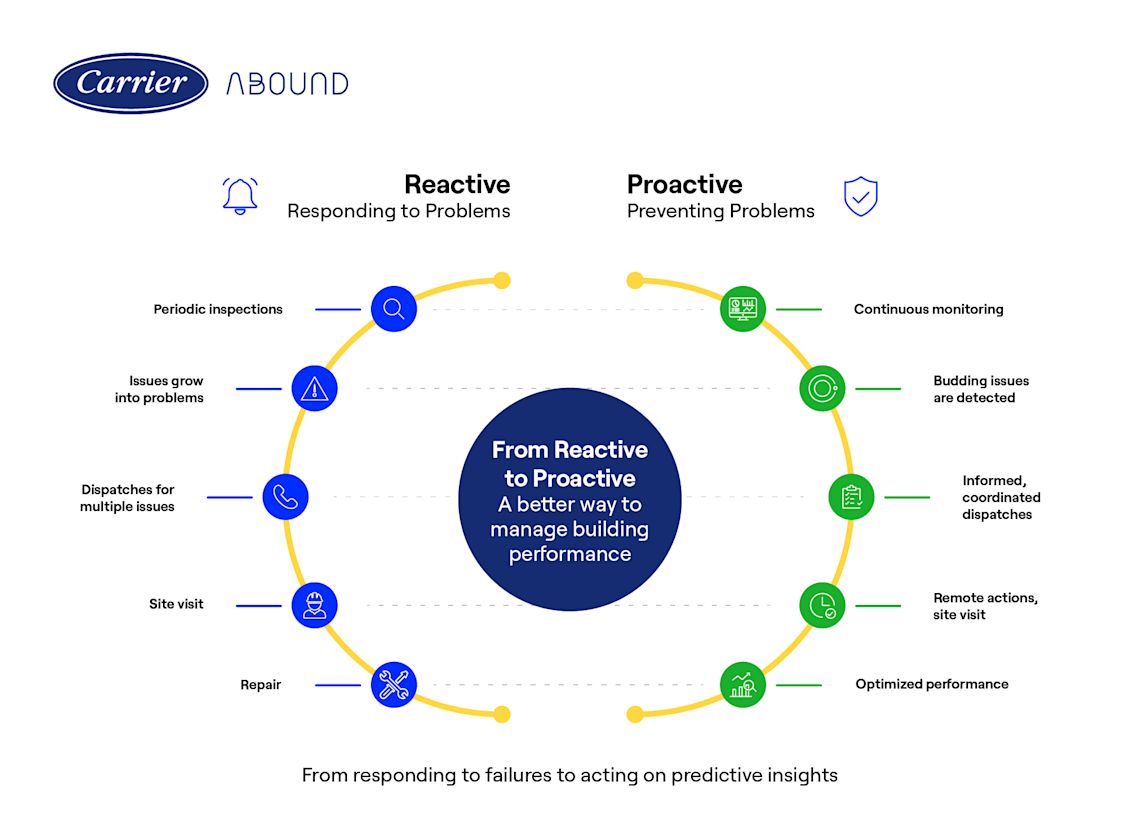
This model comes to life across the everyday challenges facility teams face. Here’s how.
1. Too Many Manual Checks & Fragmented Visibility
The issue isn’t simply access to information; it’s the time and effort required to make sense of it. Alarms, readings, reports, emails, spreadsheets, and vendor updates create a constant stream of data. In fact, industry studies indicate that maintenance teams typically spend only 30–35% of their time on actual hands-on work, which means the majority consumed by indirect activities such as searching for information, waiting, and coordination. Before action can begin, valuable time is spent interpreting this data and identifying what truly requires attention.
Once the relevant data is identified, the next challenge is making sense of it at scale. With data spread across platforms and spreadsheets, the challenge is turning it into a clear, actionable view. A unified enterprise operations view brings visibility across sites, while asset inventory and health insights provide a deeper understanding of performance. Outlier identification helps surface emerging issues early — so teams can spend less time aligning data and more time resolving issues.
Example: Consider a retail scenario where one location reports refrigeration temperature fluctuations while another flags ventilation irregularities. Individually, these issues may seem routine, but across a portfolio, they can reveal broader operational patterns that impact performance, energy use, and product integrity.
Facility managers can address this by leveraging a managed service that combines an AI- and IoT-enabled platform with a centralized command center.
This integrated approach is designed to regularly analyze data across locations to identify patterns and prioritize action. It can help remote issue resolution where possible and, when on-site intervention is required, help triage asset issues, generates work orders within existing CMMS platforms, and suppresses redundant alarms. In parallel, it helps optimize asset and space utilization until service is completed—reducing disruption without adding to the facility manager’s workload
2. Unclear Escalations & Slow Ownership
When equipment shows signs of trouble, the response chain activates instantly. Service desks look for diagnostic direction, technicians need operational clarity, operations teams assess impact, and leadership seeks assurance. While everyone is aligned on the outcome, the absence of synchronized information slows coordination and introduces uncertainty—especially across large, multi-site portfolios where this cycle repeats continuously.
A unified source of information can bring structure to this process, aligning teams through shared, reliable insight and enabling faster, more coordinated decisions at every step.
Example: Consider a scenario where multiple service requests are triggered across sites within a short window. Without clear prioritization, teams may respond based on perceived urgency rather than actual impact delaying attention to the most critical issues.
With today’s technologies, facility managers can leverage a connected, AI- and IoT-enabled platform designed to regularly ingest near real-time alarms, asset performance data, and operational context across the portfolio. The platform is designed to correlate events, prioritize issues based on impact, and generate actionable work orders within existing CMMS systems. This helps ensure that the right issues are prioritized first, ownership is more clearly defined, and escalation paths are streamlined.
By combining analytic alerting, asset health insights, and automated workflows, escalation becomes a more structured, data-driven process, which can reduce response times while maintaining alignment with mission-critical priorities.
3. Reactive Maintenance & Endless Fix-When-It-Breaks Cycles
Even with better visibility and prioritization, execution often remains reactive. Across many facilities, unplanned failures continue to disrupt operations. Research shows that reactive maintenance can typically lead to higher long-term costs and increased unplanned downtime, while planned approaches can reduce maintenance costs by 12–18%.
In some cases, technicians are dispatched only to encounter unexpected issues, such as a lack of necessary parts, leading to repeat visits. This creates a cycle that consumes valuable time, manpower, and resources. Improving first-time fix rates becomes critical to breaking this pattern.
Consider a scenario where a technician is dispatched to resolve an HVAC issue at a critical site. On arrival, the root cause isn’t immediately clear, and the required component isn’t available on-site. The visit ends without resolution, triggering a follow-up dispatch. What should have been a single intervention becomes multiple trips, delaying resolution and increasing operational cost.
Predictive intelligence helps address this challenge by equipping teams with the right information before they arrive on-site. Continuous monitoring and portfolio-wide insights help show early signs of asset performance drift, whether through unusual cycling, airflow imbalances, vibration anomalies, or temperature deviations. With this foresight, technicians can arrive prepared with the right context, recommended actions, and necessary parts, reducing repeat visits and improving first-time fix rates.
This approach aligns with broader research in predictive maintenance, which shows improved reliability, reduced downtime, and better operational efficiency through data-driven decision-making ultimately shifting maintenance from reactive to proactive.
4. Compliance & Reporting Support
Facility teams should maintain accurate records, verify task completion, and produce documentation across sites. These expectations rely on consistent, structured data. Fragmented information can lead to more time spent on including time spent gathering, validating, and reconciling supporting information.
Although final compliance remains the responsibility of the facility owner or operator, a connected digital platform can support this task by making information reporting accessible. By centralizing data, automating logs, and maintaining structured activity trails, it enables facility teams to access ready, audit-supporting reports on demand, reducing the need for manual compilation and helping with consistency across sites.
Managed services can further strengthen this foundation by providing program governance, organizing information to support compliance requirements, helping standardize across the portfolio, and delivering in the format and frequency needed. Together, the platform and service model embed audit readiness into daily operations rather than treating it as a periodic task.
5. Rising Sustainability Targets, Limited Time
Performance expectations are also expanding. Stakeholders expect tangible reductions in consumption and better sustainability, and real-time visibility into usage patterns and system behavior can help meet these expectations. Managed services bring clarity and control to this challenge. Through regular monitoring of consumption patterns and system performance, they enable the identification of opportunities to reduce waste and optimize output. Supported by predictive analytics, hidden inefficiencies are found earlier, helping facility teams lower costs while advancing sustainability goals.
Conclusion: A Smarter, Human-Centered Future
Facility management evolves when leaders gain the time to reflect, the space to plan, and the clarity to act with precision. This evolution is powered by a model where hybrid intelligence combines rules-based systems with machine learning while keeping human expertise central to decision-making.
A connected platform enables this shift by delivering a unified enterprise operations view, bringing portfolio-wide visibility into a single, coherent perspective. With centralized command center expertise aligned to corporate governance, and CMMS integration enabling smarter, more responsive work orders, teams can move from reactive coordination to intelligent execution.
As expectations continue to rise, facility managers need systems that simplify complexity while strengthening their ability to act. Modern connected solutions are designed to do exactly that—bringing foresight, operational effectiveness, and greater confidence to facility management.
Disclaimers
1. This article reflects general industry perspectives and emerging operational practices. Actual results may vary based on facility conditions, implementation approaches, and organizational requirements
2. AI-generated responses may include inaccuracies. Users should verify important information independently.
Steve Hamby, is a business and technology leader specializing in identifying growth opportunities and delivering client-focused solutions. He has strong experience leading global teams, managing programs, and driving financial performance. He serves as Co-Chair of the ConnexFM Technology Council and sits on the Futurebuilt Advisory Board. His expertise includes AI & IoT interoperability, FDD, remote resolution, technology modernization, and ESG initiatives.
Shawn Menezes leads the brand and product marketing function at Carrier Abound. He works on strategies and campaigns to drive the brand and products forward. He is passionate about contributing to the fight against climate change and communicating how technology can make energy-intensive building operations more sustainable.