
From Insights to Autonomy: Advancing AI in Building Operations
by Yogesh B., General Manager, Strategy & Product Management, Prasanna Kumar Narayana, Product Manager, and Gunjan Bharadwaj, Product Marketing Lead, Carrier Abound
SEPTEMBER 2026
For more than a decade, the building industry has invested heavily in analytics platforms, connected equipment, fault detection systems, and operational dashboards. Today, large commercial building portfolios operate across billions of connected devices that continuously generate operational information, while AI-powered analytics transform that data into an increasing volume of insights and recommendations. Yet despite these advances, industry estimates suggest that 80–90%1 of building data remains unused or unanalysed, revealing a broader challenge: generating insights has become easier, but consistently translating those insights into meaningful operational outcomes remains far more difficult.
Despite this progress, maintenance and operations across many portfolios remain fundamentally reactive. Buildings today generate vast amounts of operational information, and AI-powered tools can surface issues faster than ever before. While insight generation has become increasingly automated, maintenance execution—from prioritization and work orders to service coordination and verification—often remains manual and fragmented.
So, organizations are becoming increasingly effective at generating intelligence but translating that intelligence into action remains a challenge.
The Missing Link Between Intelligence and Execution
Industry research suggests that the challenge is no longer generating insights—it is operationalizing them.
- The Ingestion Trap: Insights are generated, but maintenance work still depends on human interpretation and initiation. Research published in Science Directs’ Energy and Buildings2 -category-highlights that building operators increasingly rely on data-driven analytics to generate long-term operational insights. However, the study notes that these insights only deliver value when operators can effectively interpret them and translate them into energy-saving actions—an aspect that has low adoption, leaving the implementation of the intelligence to be heavily dependent on manual decision-making.
- The Integration Barrier: Operational intelligence remains fragmented across disconnected systems. Researchers from Western Michigan University3 identified interoperability and semantic integration as key challenges in intelligent facility management. They also noted that heterogeneous building systems continue to face limitations in reliable data exchange and system integration. As a result, consolidating information across systems to enable timely, informed action remains difficult.
- The Cognitive Load: As analytics become more sophisticated, interpreting and acting on insights remains a human challenge. Research published in Science Direct’s Energy and Buildings4 category - found that data-driven energy insights continue to increase in quantity and complexity, yet only 2 of 11 building operators interviewed at that time were willing to implement analytics-generated control changes in response to the data modelling techniques presented to them. This highlighted the knowledge gaps and decision burden that continue to limit the effective use of operational intelligence.
As operational intelligence continues to advance, effective execution will be a driving factor in the value of AI support. Autonomous Maintenance Management Systems (AMMS) is an emerging concept, that can help extend building intelligence beyond insights toward more structured execution.
Making Intelligence Operational
As organizations generate increasing volumes of operational intelligence, the next measure of AI's value is not just the quality or timeliness of insights it generates, but also how the insights are effectively implemented.
Detecting faults, anomalies, and inefficiencies is becoming a baseline capability. The next stage of maturity includes helping operations teams determine what action should happen next. This requires expanding the role of AI beyond detecting and diagnosing issues to enabling and guiding appropriate action. Rather than presenting operators with a growing stream of alarms, diagnostics, and recommendations, intelligent systems must be able to evaluate equipment conditions in context, assess operational impact, and determine the most appropriate response.
The objective is not simply to make operators more aware. It is also to ensure that intelligence leads to timely, consistent action. In other words, intelligence should become operational.
From Insights to Execution
An Autonomous Maintenance Management System (AMMS) is designed to bridge the gap between insight generation and maintenance execution. Some organizations are beginning to implement solutions on this concept-that apply operational logic to help determine the appropriate response and initiate the next steps within established workflows. Rather than stopping at fault detection or recommendations, such solutions are designed to apply operational logic to help determine the appropriate response and initiate the next steps within established workflows.
This is achieved by:
- Interpreting equipment performance in the context of operating conditions: Evaluating asset behaviour against operating history, performance baselines, and known failure scenarios based on the operational environment.
- Determining the appropriate response path: Identifying whether an issue requires immediate escalation, remote intervention, technician dispatch, or continued monitoring.
- Orchestrating maintenance workflows: Initiating standardized actions, service recommendations, and work-order processes to ensure consistent execution.
- Enabling decision-making at scale: Applying the same operational logic across assets, sites, and portfolios, reducing variability in how issues are managed.
The successful result would be a more connected operational model in which intelligence can extend beyond identifying and diagnosing issues to helping decide the appropriate response and initiating the actions required to resolve them.
Introducing Autonomy Through Structured Decision-Making
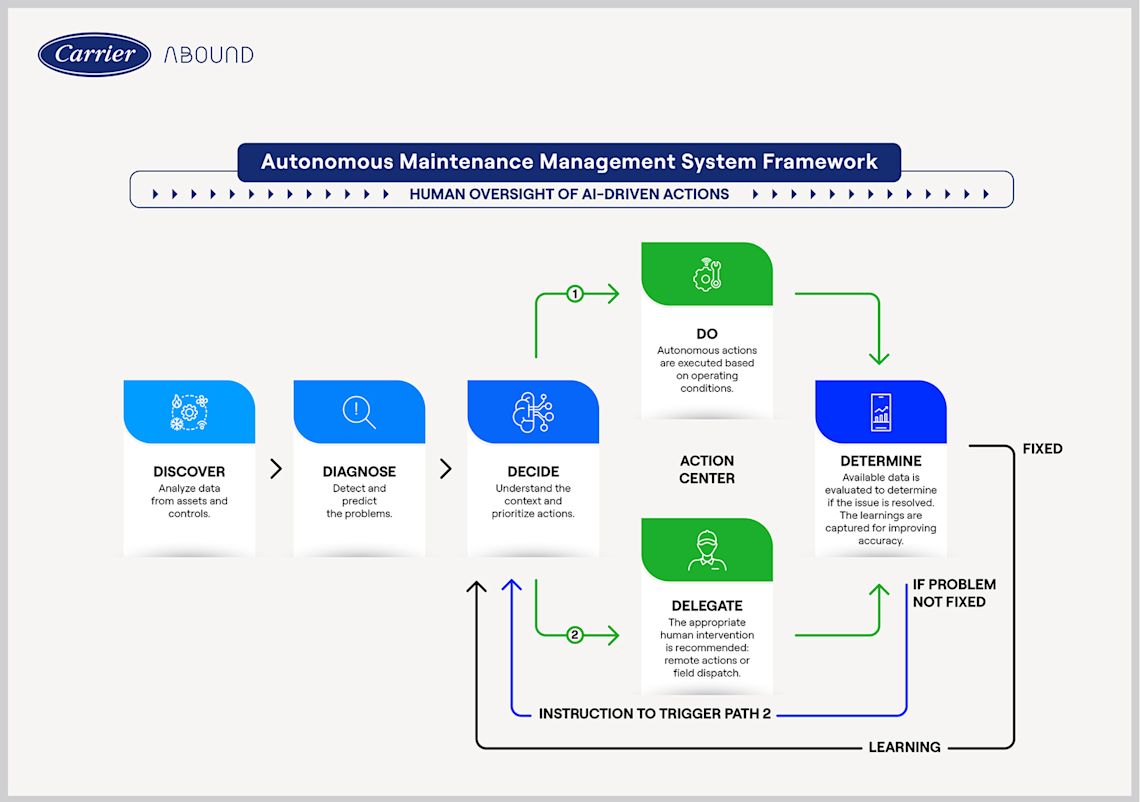
Within an Autonomous Maintenance Management System (AMMS), equipment conditions would be evaluated against known operating scenarios, failure modes, and response rules. The system is being designed to assess operational impact, recommend the appropriate course of action, and initiate the next step within predefined limits.
For example, when a rooftop unit (RTU) exhibits signs of performance degradation, the system is being designed to evaluate the condition against established operating thresholds and recommend the appropriate response path:
Depending on the severity and nature of the issue, the system may:
- Take localized automated action: Localized or remote automated actions are executed via edge devices or BMS applications to manage deviations under low-risk conditions. Where spare capacity exists, system load is rebalanced to maintain performance—reducing the need for emergency dispatches and enabling a shift toward planned maintenance, supporting operational savings.
- Initiate maintenance workflows: When field intervention is required, automatically generate work orders, trigger service workflows, and provide the information needed to support faster resolution.
- Escalate critical conditions: Route high-priority issues to the appropriate teams when operational, safety, or business impacts exceed predefined thresholds.
This structured approach ensures that intelligence does not stop at identifying a problem. It enables insights to trigger consistent, governed actions, reducing response times and improving operational consistency across assets, sites, and portfolios.
Human Oversight as a Foundation for Trust
As automation increases, transparency and governance become more important. Transparency is foundational for transitioning from insight-driven operations to automated execution.
For many organizations, this evolution may happen gradually. Building portfolios are likely to progress through stages of maturity:
Advisory Insights → Approval-Based Decisions → Selective Autonomous Actions
At each stage, operators need visibility into what actions are being recommended or executed, why those decisions were made, and the conditions under which they occurred. Human oversight remains essential for governance, exception handling, and strategic decision-making.
Automation can therefore help in reducing repetitive manual effort and operational friction so that maintenance teams can focus on higher-value activities while issues can be addressed faster and more consistently.
Why This Shift Matters Now
Aging infrastructure, rising energy costs, labor shortages, environmental regulations, expanding portfolios, and higher uptime expectations are making traditional reactive maintenance models increasingly inefficient.
At the same time, the industry has made significant progress in digitizing buildings and generating operational intelligence. The next challenge is ensuring that intelligence is consistently acted upon.
This is not simply an AI problem. It is also an execution problem—one that requires trusted data, connected workflows, and structured decision-making. As organizations work to close the gap between insight and execution, the focus will likely shift to solutions that connect the loop and drive outcomes.
The future of building operations may not be defined by how much intelligence buildings can generate, but by how effectively that intelligence can be translated into action. Automation represents the next step in that evolution—uncovering insights, recommending, and executing to help buildings operate more consistently, efficiently, and at scale.
Disclaimer
This article reflects a general industry perspective and is intended for informational purposes only. Outcomes may vary based on early implementation results, building configuration, system integration, and operational practices.
References
1https://www.huawei.com/en/media-center/transform/25/01-index
2https://www.sciencedirect.com/science/article/abs/pii/S0378778822004091
3https://link.springer.com/article/10.1007/s42524-023-0254-4
4https://www.sciencedirect.com/science/article/abs/pii/S0378778822004091
Yogesh B., General Manager, Strategy and Product Management, Carrier Abound, leads strategy, product roadmap, and growth initiatives for Abound Insights. He brings over 20 years of experience across product management, digital transformation, SaaS, IoT, and building technologies, with a focus on developing scalable digital solutions that deliver measurable business value.
Prasanna Kumar Narayana, Product Manager, Carrier Abound, focuses on Abound Insights and intelligent building operations. His expertise spans predictive maintenance, AI-powered analytics, digital transformation, edge automation, and IoT-enabled solutions that improve asset reliability, operational efficiency, and sustainability.
Gunjan Bharadwaj, Product Marketing Lead, Carrier Abound, is a product marketer and storyteller who explores how technology can solve real-world challenges. She collaborates with global teams to bring innovative products and features to market, translating complex capabilities into clear, practical insights on the trends shaping the future of buildings and their operational performance.