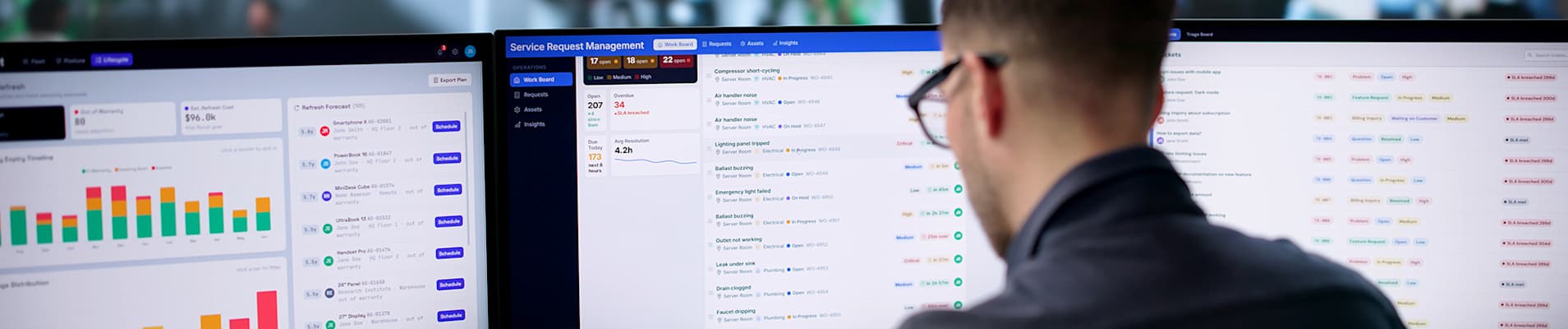
The Visibility Challenge in Modern Facility Management
At 2:30 a.m., the mechanical room of a remote facility is dark and empty. There is no one standing in the mechanical room of a remote facility. No one is listening for an unusual vibration in a pump or watching a chiller slowly drift out of specification.*
This gap in oversight represents a vulnerability where operational inefficiencies and equipment issues can quietly begin, and that is a reason why remote building monitoring matters.
For facility and operations teams managing multiple sites, the challenge is not simply keeping buildings running. It is also knowing what is happening across those buildings without always having to be physically present at every location.
That challenge is becoming increasingly difficult to manage. Rising energy costs, labor shortages, expanding portfolios, and growing sustainability expectations are placing greater pressure on facility teams. At the same time, modern buildings generate vast amounts of operational data from HVAC systems, refrigeration equipment, lighting controls, energy meters, and other connected assets.
Traditional approaches such as scheduled inspections, manual data collection, and reactive maintenance often provide only a snapshot of building performance. Between site visits, equipment issues, and energy waste, operational inefficiencies can go unnoticed until they begin affecting costs, comfort, or uptime.
To gain greater visibility and respond to issues earlier, many organizations are turning to remote building monitoring solutions to proactively manage building performance across their portfolios.
What Is Remote Building Monitoring?
Remote building monitoring is a technology-enabled approach that allows organizations to continuously monitor building systems, equipment, and environmental conditions from a centralized location.
Rather than relying solely on scheduled inspections, connected building assets continuously generate operational data that can be collected, analysed, and reviewed remotely. This may include data from critical building systems such as HVAC and refrigeration equipment, lighting controls, energy infrastructure, environmental sensors, and other operational assets that influence building performance. The goal is not simply to collect more data.
The goal is to transform building data into actionable insights that help facility teams make faster, more informed decisions. When implemented effectively, remote building monitoring provides a clearer understanding of how facilities are operating, where performance is changing, and when intervention may be required.
What Remote Building Monitoring Actually Requires
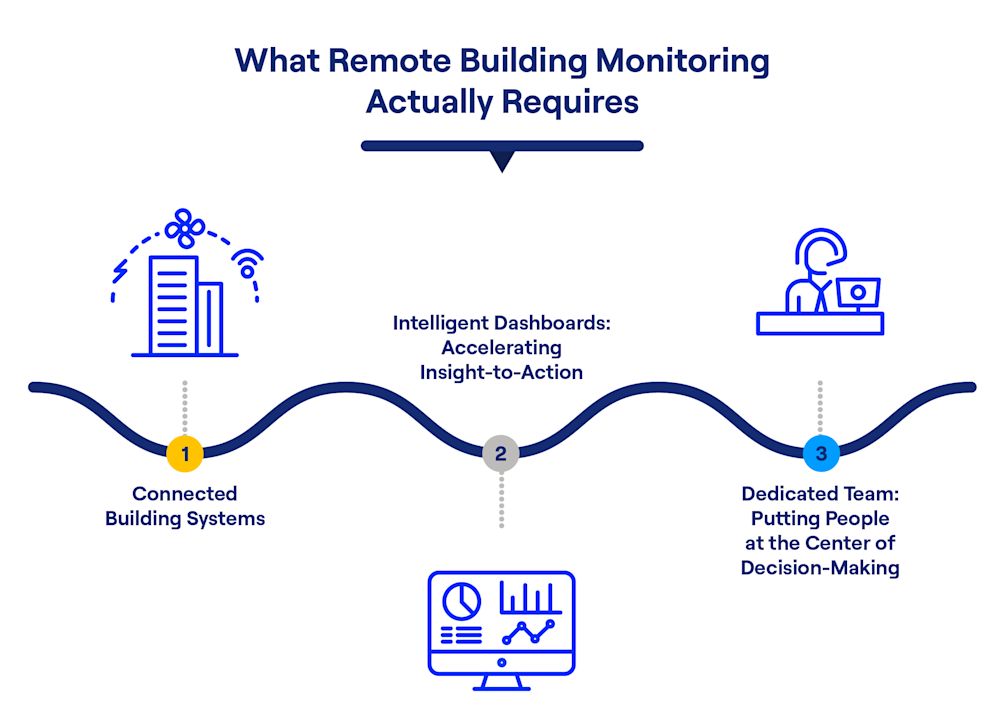
While remote building monitoring is often associated with dashboards and alerts, sustained efficiency depends on a broader architecture of continuous data integration and structured operational workflows. Successful programs often depend on three critical elements working together:
1. Connected Building Systems
The first requirement is connectivity. Building systems and equipment must be capable of transmitting operational data from the site to a centralized platform. Whether monitoring HVAC systems, refrigeration equipment, lighting controls, or energy infrastructure, data must move beyond individual controllers and local systems to become useful at scale. Without connectivity, remote monitoring simply cannot function effectively.
2. Intelligent Dashboards: Accelerating Insight-to-Action
Passive visibility alone is no longer enough. Standard dashboards that merely display real-time numbers can contribute to alert fatigue rather than decreasing it. More advanced dashboards can help bridge the gap between raw data and action. By embedding predictive analytics directly into the interface, these advanced platforms present asset status, immediate insights, and prioritized recommendations on a single screen. This can reduce manual troubleshooting and support faster decision-making, allowing lean teams to resolve anomalies earlier.
3. Dedicated Teams: Putting People at the Center of Decision-Making
Monitoring creates visibility, but people create value. Behind every smart building platform, there should be a dedicated team of experts to make sense of the data. Data alone cannot fix a faulty chiller or optimize an HVAC cycle; better value can be achieved when portfolio data is routed directly to a dedicated operational team—such as a centralized Remote Operations Center (ROC)—trained to bridge the gap between software alerts and human strategy. This model can help redistribute decision-making responsibilities and support on-site teams.
Instead, this specialized engineering team is responsible for interpreting insights, establishing operational priorities, and guiding important. When issues arise, teams evaluate conditions and determine an appropriate course of action. Whether executing a remote adjustment, dispatching a technician, or escalating to a vendor, this approach helps ensure that technology supports operational effectiveness.
From Building Signals to Operational Decisions
One of the most significant advantages of remote building monitoring is the ability to identify issues earlier.
Consider a portfolio of facilities spread across multiple locations. One site begins consuming more energy than expected overnight. Another experiences abnormal equipment cycling. A third shows temperature conditions gradually moving outside expected ranges. Individually, these changes will trigger a local alert or a reaction from the individual managing that specific location, but visibility remains trapped at the site level. Without centralized data, these events are treated as isolated incidents rather than early indicators of underlying operational issues.
Through continuous monitoring and analytics, these signals become visible sooner and at an enterprise scale. A centralized operational layer allows organizations to connect the dots across the entire portfolio, enabling facility teams to review live operational data, investigate anomalies, spot trends, and determine the appropriate response before performance deteriorates further. This changes the rhythm of facility management. Instead of waiting for scheduled inspections or relying on local troubleshooting, organizations can gain ability to monitor, detect, assess and respond based on real-time operating conditions. The result is a decisive shift from reactive actions toward more proactive operations.
Key Benefits of Remote Building Monitoring
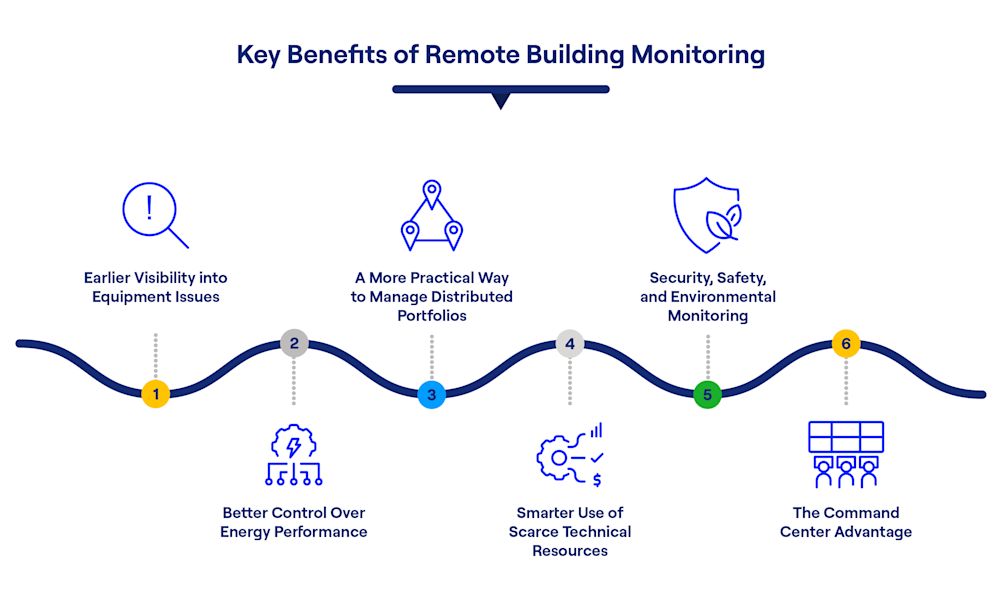
1. Earlier Visibility into Equipment Issues
Remote monitoring solutions continuously analyze data from critical assets such as HVAC systems, refrigeration equipment, pumps, and other mechanical infrastructure. By identifying abnormal operating conditions early, facility teams can investigate potential issues before they develop into costly failures or unplanned downtime. This allows maintenance activities to be prioritized based on actual equipment condition rather than relying exclusively on fixed schedules, helping organizations improve reliability while extending asset life.
2. Better Control Over Energy Performance
Energy waste rarely occurs all at once. More often, it develops gradually through inefficient equipment operation, overridden controls, incorrect setpoints, or systems operating outside intended schedules. Remote monitoring platforms help organizations identify these patterns earlier by providing continuous visibility into energy consumption and system performance. With better insight into how buildings use energy, facility teams can take corrective action sooner, which can help reduce operating costs, improve efficiency, and support broader sustainability goals.
3. A More Practical Way to Manage Distributed Portfolios
As building portfolios grow, maintaining consistent oversight becomes increasingly difficult. Remote building monitoring provides a centralized view of operational performance across multiple facilities, allowing facility leaders to compare sites, benchmark performance, and identify underperforming assets more efficiently. This centralized visibility is particularly valuable for geographically dispersed, lightly staffed, or unmanned locations where regular on-site oversight may not be practical.
4. Smarter Use of Scarce Technical Resources
Not every issue requires an immediate site visit, a critical factor at a time when skilled technicians are becoming increasingly scarce. With access to real-time operational data and the ability to investigate issues remotely, facility teams can accurately assess conditions and determine the appropriate course of action before dispatching personnel. This targeted approach can help reduce unnecessary truck rolls, improve technician productivity, and help ensure that your limited, high-value field resources are focused on the complex issues that require in-person attention.
5. Security, Safety, & Environmental Monitoring
Remote building monitoring solutions can also provide visibility into environmental and operational conditions that may affect occupant safety, compliance, or business continuity. Connected sensors and building systems can monitor factors such as temperature, humidity, indoor air quality, equipment alarms, and other critical conditions. Automated alerts are designed to notify facility teams when operating conditions fall outside predefined thresholds, enabling faster investigation and response. By providing continuous oversight of both equipment and several environmental conditions, organizations can help strengthen resilience and support compliance requirements.
6. The Command Center Advantage
To truly scale these benefits, the most mature remote monitoring strategies extend beyond standalone connectivity by introducing a centralized operational layer managed by a dedicated command center team. This brings together skilled resources who are specifically trained to work with connected systems, connect the dots, and initiate actions.
The command center team reviews incoming information, identifies trends, and helps prioritize issues, and coordinate responses. A dashboard can indicate that something has changed, but these experienced teams analyze data patterns that help report critical findings, direct field personnel, and inform broader business strategies. For organizations managing large or complex portfolios, this operating model can create a more disciplined process for issue identification, triage, escalation, and follow-through. Technology enables visibility and insights; a centralized operating model helps organizations turn those insights into action and achieve more consistent operational outcomes.
Remote Building Monitoring Is All About Running Buildings Better
One of the most important goals of remote building monitoring is to build a more effective building operating model; one where connected systems provide timely operational data, where centralized platforms turn that data into actionable insights, and where the right people can direct responses earlier to help mitigate performance impact. For facility managers and operations leaders, this can result in fewer blind spots, earlier visibility into emerging issues, better control over energy performance, and a more scalable approach to managing complex portfolios.
As organizations balance uptime requirements, sustainability goals, cost pressures, and workforce constraints, remote building monitoring is increasingly seen as a practical foundation for proactive, data-driven facility management. Ultimately, the organizations that gain the greatest value from remote building monitoring may not simply be those collecting the most data, but rather the ones that are also able to use that data to make faster and more accurate decisions, optimize performance, and continuously improve operations. In an environment where every asset, every kilowatt, and every operational decision matters, the ability to turn building data into meaningful action is becoming a critical advantage.
Disclaimer
*Note: All scenarios, times, and portfolio examples used in this document are illustrative and hypothetical, intended solely for demonstration purposes to showcase the capabilities of remote building monitoring architectures.