
Smarter Stores, Better Margins: AI & IoT in India’s Retail Sector
by Urmi Bhattacharjee, Sales & GTM Strategy, Carrier Abound India
JULY 2026
India’s retail story is expanding at pace — and that scale is one important reason why profitability has become a board-level priority. India’s retail sector, valued at US$1.06 trillion in 2024, is projected to reach $1.93 trillion by 20301. For retailers managing large networks of physical stores, this growth does not automatically translate into stronger margins. Instead, it raises a more pressing leadership question: how efficiently are our stores operating today?
For retailers in India, operational intelligence is emerging as an important driver of profitability. As competition intensifies and costs accumulate store by store, profitability is increasingly shaped by day to day operations — how assets perform, how energy is consumed, how maintenance is planned, and how consistently operating standards are followed across locations. These factors, repeated across hundreds of stores, can significantly influence margin and return on capital. In turn, store operations have moved into greater executive focus, with CXOs and retail planning teams seeking clear accountability and more predictable financial outcomes.
This is where Artificial Intelligence (AI) & Internet of Things (IoT) can become strategic. Not only as a technology experiment, but also as a potential profitability enabler — translating operational data from physical stores into financial insight that enables leadership to connect store level decisions directly to margin impact. In the journey from data to business outcomes, there is a real opportunity in turning operational visibility into more consistent, efficient execution across the store network.
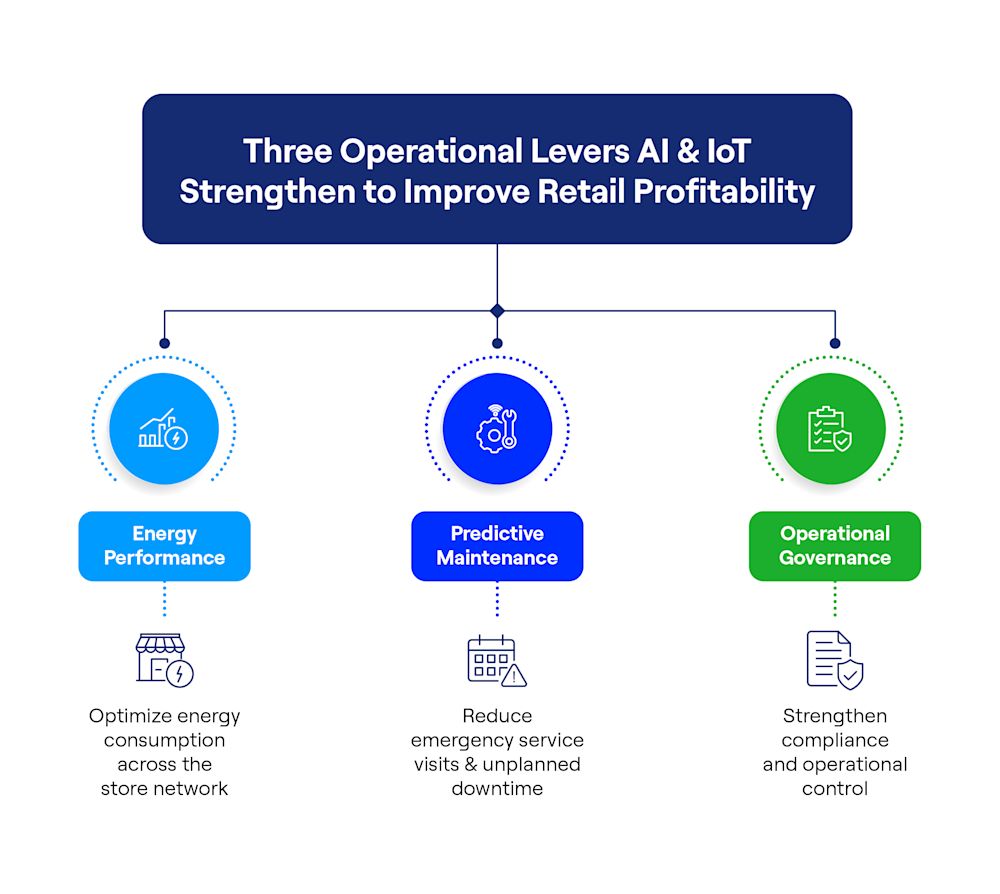
Where the Money Is: Three Profit Levers AI & IoT Strengthens in Physical Stores
1) Energy performance without compromising store experience
In physical retail, energy decisions are made every day across stores — often manually and inconsistently. Heating, Ventilation, and Air-Conditioning (HVAC) often accounts for a significant share of total energy consumption in retail environments – typically around 45%2. Small deviations in operating hours, lighting and signage operations, temperature setpoints, or overrides may appear insignificant at a single store-level. Across a large network, such deviations can compound into cost inefficiencies and potential margin dilution.
AI & IoT can deliver value by bringing enterprise-level visibility and discipline to energy usage across the portfolio*. By enabling leadership to see what is running, when it is running, and where operating standards are being overridden, retailers can be in a better position to optimize energy consumption. However, cost optimization shouldn’t come at the expense of customer experience. This balance is critical. Research indicates that store environment factors such as temperature and lighting influence customer comfort, dwell time, and purchase behaviour3. When energy optimization compromises in store comfort, the apparent cost savings are often offset by weaker footfall, reduced engagement, and lower conversion — resulting in margin erosion rather than sustainable profitability improvement.
2) Maintenance optimization through predictability, not reaction
Reactive maintenance is one of the factors potentially contributing to margin erosion in retail operations. Unplanned equipment failures, emergency servicing, repeated breakdowns, and spare-part delays disrupt store operations and drive avoidable costs. More importantly, they introduce operational risks that may directly affect uptime and customer experience.
AI & IoT enables a shift from reactive to predictive maintenance. By providing early indicators of asset performance and potential failures, retailers gain the ability to intervene before failures occur. This preparedness can help reduce emergency expenditure, improve asset reliability, and stabilize store operations, thereby helping to optimize asset lifecycle management. Over time, by shifting from reactive to proactive maintenance, retailers can unlock ~10-20% in energy savings while improving system reliability and operational resilience4.
3) Operational governance that protects margin at scale
The third lever is governance — an area where cost leakage often goes unnoticed. Parameters such as power factor, safety system uptime, and adherence to operating standards may appear technical, but lapses frequently result in penalties, incidents, or avoidable financial exposure.
AI & IoT-enabled visibility helps leadership identify deviations early and enforce consistency across locations. By strengthening compliance and operational control, retailers may avoid hidden losses that accumulate store by store. This governance layer also supports better retail planning decisions. When leadership has a clear view of operational performance and cost behavior, it becomes possible to identify stores that are structurally inefficient and take informed action — whether through corrective measures, retrofits, or rationalization.
Moving Beyond Pilots to Scalable Profit Impact
AI & IoT programs often fail not because of technology, but because of how they are deployed. Treating them as isolated pilots or experiments limits impact – especially for retailers operating large, geographically dispersed networks. Real value comes from consistent execution and portfolio-wide execution.
The path forward is clear: select stores strategically, define metrics upfront, prove outcomes, and scale systematically. In a recent deployment, a retailer launched a 100 store pilot over five months with clearly defined success metrics. Against an initial target of 3.5% energy savings, the program delivered 6.7% average monthly savings in its final phase. It also achieved 96% internal temperature compliance, reduced temperature-related complaints by 35% year-on-year, and lowered on-site interventions through higher remote resolution — driving measurable maintenance cost savings**. When done right, pilots become catalysts, not isolated exercises that demonstrate impact and support a broader business case.
Ultimately, a shift from store-level activity to portfolio-wide control is required. When executed effectively, such programs have delivered average savings of up to 10% over time for some customers, and helped optimize maintenance costs**. AI and IoT can create value when they enable leadership to act earlier, enforce consistency, reduce cost leakage, and support customer experience and operational reliability**. In India’s fast-growing retail market, scale alone is no longer enough to sustain profitability; it will depend on how intelligently that scale is managed – and AI & IoT can provide an important foundation for that shift.
References
1 https://www.deloitte.com/in/en/about/press-room/india-s-us-1-06-trillion-retail-sector-is-set-to-reach-1-93-trillion-by-2030.html
2 https://www.energytrust.org/wp-content/uploads/2024/10/Run-Better-Infographics_Retail.pdf
3 https://www.aodr.org/xml/04145/04145.pdf
3 https://www.mdpi.com/2075-5309/15/10/1677
4 https://www.constructionspecifier.com/proactive-hvac-maintenance-balancing-costs-with-sustainability/
Disclaimers
*AI-generated output may include inaccuracies. Users should verify important information independently
**This deployment is based on a specific implementation and reflects the experience of a particular customer under its unique circumstances. Results may vary.
Urmi Bhattacharjee leads Sales & GTM Strategy for Carrier Abound India, spearheading the adoption of AI and IoT-driven energy and operational efficiency solutions. She drives regional revenue growth and brand awareness among multi-site enterprises and commercial and industrial operators.