
The Future of Intelligent Buildings: How Data-Driven Spaces Are Redefining Human Experience
Making the data already inside your buildings work harder to cut energy use, improve comfort, and help facility teams act sooner.
OCTOBER 2026
In the endeavor to maintain more efficient, comfortable, and resilient commercial properties, the immediate impulse is often to invest in shiny new technology. However, improving building performance may not require replacing existing infrastructure. Instead, it comes down to how existing building systems are operated.
A 2024 study highlights this potential: by jointly optimizing indoor CO₂ concentration and temperature, researchers demonstrated that day-ahead HVAC control adjustments could reduce energy demand by up to 17% while maintaining optimal indoor conditions.
This finding points to a broader shift in smart-building performance. Building systems do not operate in isolation. Energy use, indoor environmental conditions, occupancy, equipment behavior, and control strategies continuously influence one another. Optimizing any single factor without considering the rest leaves significant opportunities and potential trade-offs unaddressed.
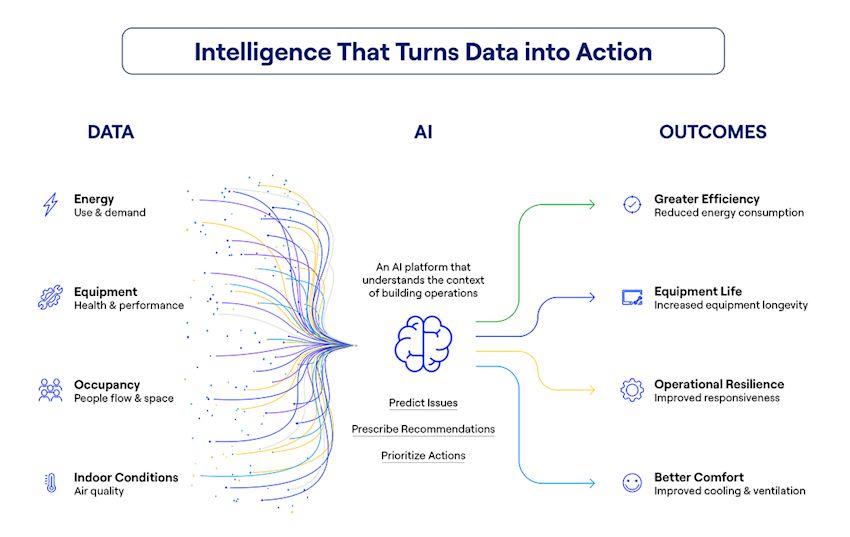
Rather than using technology simply to automate individual functions, some forward-thinking organizations are bringing together information from across their portfolio to identify patterns, anticipate changes, and elevate human and operational experiences. The opportunity is not necessarily to add more systems, but to make the technology and data already within a building work harder.
When Data Starts to Tell a Story
A building rarely reveals a performance issue through a single signal. The most actionable clues emerge when disparate pieces of information are viewed together.
An HVAC system running longer than expected might reflect higher occupancy, changing outdoor conditions, a control sequence, or declining equipment performance. An increase in energy consumption could indicate higher demand—or an asset operating outside its normal range. Individually, these signals appear routine; together, they can reveal a more clear pattern.
This is where analytics can add an valuable layer to conventional building monitoring. By integrating data from equipment, energy usage, occupancy, and environmental conditions, data-driven models can help identify subtle shifts in performance that may otherwise go unnoticed.
Recent research underlines this practical potential:
- Fault Detection in the Wild: A 2024 study developed an automated HVAC fault-detection framework using raw, unlabelled data taken directly from a live building automation system, demonstrating that routine operational data can be used to pinpoint and diagnose specific equipment faults without simulated environments.
- Energy Impact vs. Feedback Gaps: A 2025 critical review of field implementations found that from the analysed studies reviewed, 95% of studies reporting post-implementation energy metrics achieved a greater than 10% performance improvement. However, the review also reported that 90% of those same studies did not gather feedback from building operators or occupants post-implementation.
That gap is critical. The success of a smart-building model cannot be measured solely by how accurately it predicts an outcome; it must be evaluated by what changes in the real world once that insight is delivered.
To move building analytics from a purely technical capability to a core operational tool, the data must answer fundamental practical questions:
- Does it inform a better maintenance decision?
- Does it refine a control strategy?
- Does it reduce energy use without compromising occupant comfort?
- Does it empower facility teams to intervene earlier?
What It Looks Like in Practice
Consider this example of a major shopping center in Australia with over 170 stores, where HVAC performance was traditionally managed through a mix of standard automation, fixed schedules, and reactive interventions. According to this case study, limited real-time visibility made it more difficult to identify emerging issues, while static control strategies presented opportunities for efficiency improvements.
Rather than replacing the center's existing building automation system, the strategy focused on layering intelligence over the existing infrastructure. An analytics layer was deployed atop their WebCTRL 8.0 Building Management System (BMS), connecting operational data from HVAC equipment and applying predictive analytics alongside targeted control improvements. These included Trim & Respond strategies, outdoor-air reset with optimum-start scheduling, BMS tuning, and data-driven maintenance lifecycle planning.
The case study reported the following results:
- 11,600+ kWh in energy savings achieved during the first three months.
- 8% lower AHU energy consumption in Q4 2025 compared to Q4 2024.
- 4-month ROI: Energy savings fully offset the identified software deployment cost within four months.
The case study also reported operational changes. The facility team transitioned from reacting to alarms and tenant complaints to identifying potential equipment issues before observed impact comfort or performance. The reported value came from using existing building data to support important changes in how the building was controlled, monitored, and maintained, rather than from adding another dashboard alone.
Beyond Energy: Optimizing the Building as a Whole
Energy performance is a vital metric, but it is only one component of overall building performance. A change that reduces energy consumption can inadvertently impact thermal comfort, indoor air quality, equipment lifespan, or maintenance schedules. Optimizing one outcome without considering the others simply shifts the problem downstream.
This interconnectedness makes the facility operator’s objective broader and more nuanced:
- Occupancy directly shapes ventilation and cooling requirements.
- Equipment health dictates both energy efficiency and long-term asset reliability.
- Adaptive control strategies must balance peak efficiency with real-time room responsiveness.
This multi-objective reality is increasingly shaping academic and industry research. For instance, a 2024 Energy and Buildings study used real-world classroom data to design HVAC controls that explicitly balance thermal comfort with energy savings, rather than prioritizing energy reduction at the expense of the indoor environment.
For facility leadership, the central question shifts from "How much energy can we save?" to a more holistic mandate: "How can the building deliver the optimal human experience and technical performance effectively and efficiently?"
When energy, comfort, asset health, and operational resilience are managed as connected outcomes, building intelligence delivers its true value.
Making Intelligence Work at Scale
The true potential of a data-driven strategy emerges when expanding it across an entire enterprise or real estate portfolio. However, scaling across multiple properties introduces a distinct set of operational challenges.
Buildings rarely share identical foundations. They vary in BMS platforms, equipment types and models, control architectures, communication protocols, occupancy schedules, and maintenance routines. A solution optimized for a single modern office cannot simply be pasted onto a legacy retail or mixed-use site.
This makes flexible, interoperable architecture vital. Depending on system compatibility, scalable strategies may avoid a full system overhaul by overlaying existing systems and progressively building analytics, controls, and data capabilities around current investments.
At the same time, standardized data models and performance metrics are essential to enable meaningful comparisons across sites, identify recurring equipment issues, and replicate proven operational wins.
Crucially, portfolio-scale analytics often generate more insights than facility teams can manually process. Intelligence at scale must therefore focus on intelligent prioritization separating routine noise from high-priority equipment faults and identifying systemic trends across sites. Patterns detected in one building can proactively inform maintenance strategies across other similar buildings, driving continuous improvement without turning every new site into a bespoke technology project.
Conclusion
The future of smart buildings is not about connecting more devices or generating larger volumes of data for its own sake. It is about translating the data already flowing through a facility into actionable operational clarity.
From co-optimizing energy and indoor comfort to deploying predictive maintenance over legacy automation systems, meaningful performance gains may not require starting from scratch. They require the deliberate integration of data, analytics, adaptive controls, and human expertise.
Ultimately, the true promise of smart buildings will not be measured by the amount of technology built into a facility, but by how effectively that technology empowers people to operate, optimize, and experience the built environment.
Disclaimers
Results reflect this specific implementation and may vary by building, operating conditions, configuration, and other factors.